Tile demolition and floor preparation, Etobicoke and Toronto.
The part of the job that decides how the new floor looks, and the part every low quote skips.
Send a few photos and the rough size — you get a written price the same day. No site visit, no sales call.
What's included
Everything in the quote, listed.
Written out so nothing appears as an extra later. If something on your job falls outside this, it is named in the quote — not discovered on the invoice.
- Old tile, mortar bed, backer board and underlay removed down to the structure
- Dust control — sheeting, sealed doorways and vacuum extraction at the tool
- Debris bagged and removed from site
- Subfloor inspected for rot, movement, deflection and old moisture damage
- Fasteners added or the subfloor rebuilt where it moves
- Levelling compound or grinding to bring the floor into plane
- Uncoupling or crack-isolation membrane where the substrate needs it
- Floor left clean, flat and primed, ready to tile
How it is done
The parts of the job you will never see again.
Once the tile is down, every quote looks the same. This is what separates them while the floor is still open.
- 01
Dust is controlled at the tool, not swept up afterwards
Tile removal makes silica dust, and it travels through a whole house. Doorways get sealed, the area gets sheeted and extraction runs at the tool. This is the difference between a renovation you can live through and one that leaves grit in every room for a month.
- 02
It comes off down to the structure
The old mortar bed and adhesive come off too, not just the tile. Leaving a rough bed and tiling on top of it means the new floor inherits every problem the old one had, and sits high at the doorways.
- 03
The subfloor is judged before anything is ordered
Once it is open you can see what was hidden — rot around a toilet flange, deflection between joists, a slab crack that is still moving. That is the moment to decide, with the room open and photographed, not after new tile is down.
- 04
Movement gets fixed, or it gets isolated
A floor that flexes cracks tile and grout. Either it is stiffened — extra fasteners, blocking, an added layer — or, where the movement is a live slab crack, an uncoupling membrane goes in so the crack cannot telegraph into the new floor.
- 05
Flat is measured, not judged by eye
The floor is checked with a straightedge and brought into plane with levelling compound or grinding, to the tolerance the chosen tile format needs — tighter for large slabs than for a small mosaic.
From his jobs
-
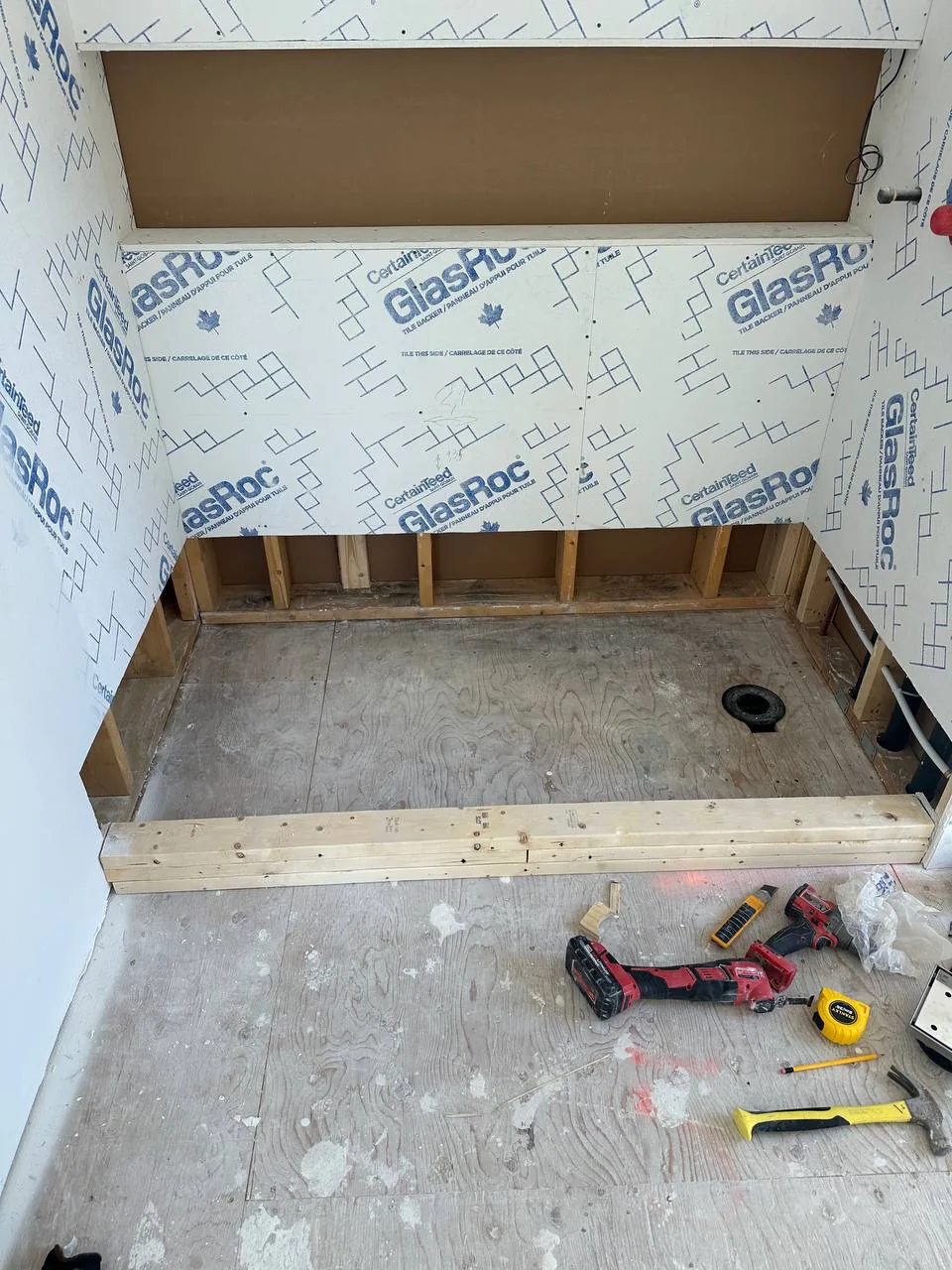
Down to bare board, with new blocking in — where a tear-out actually ends -
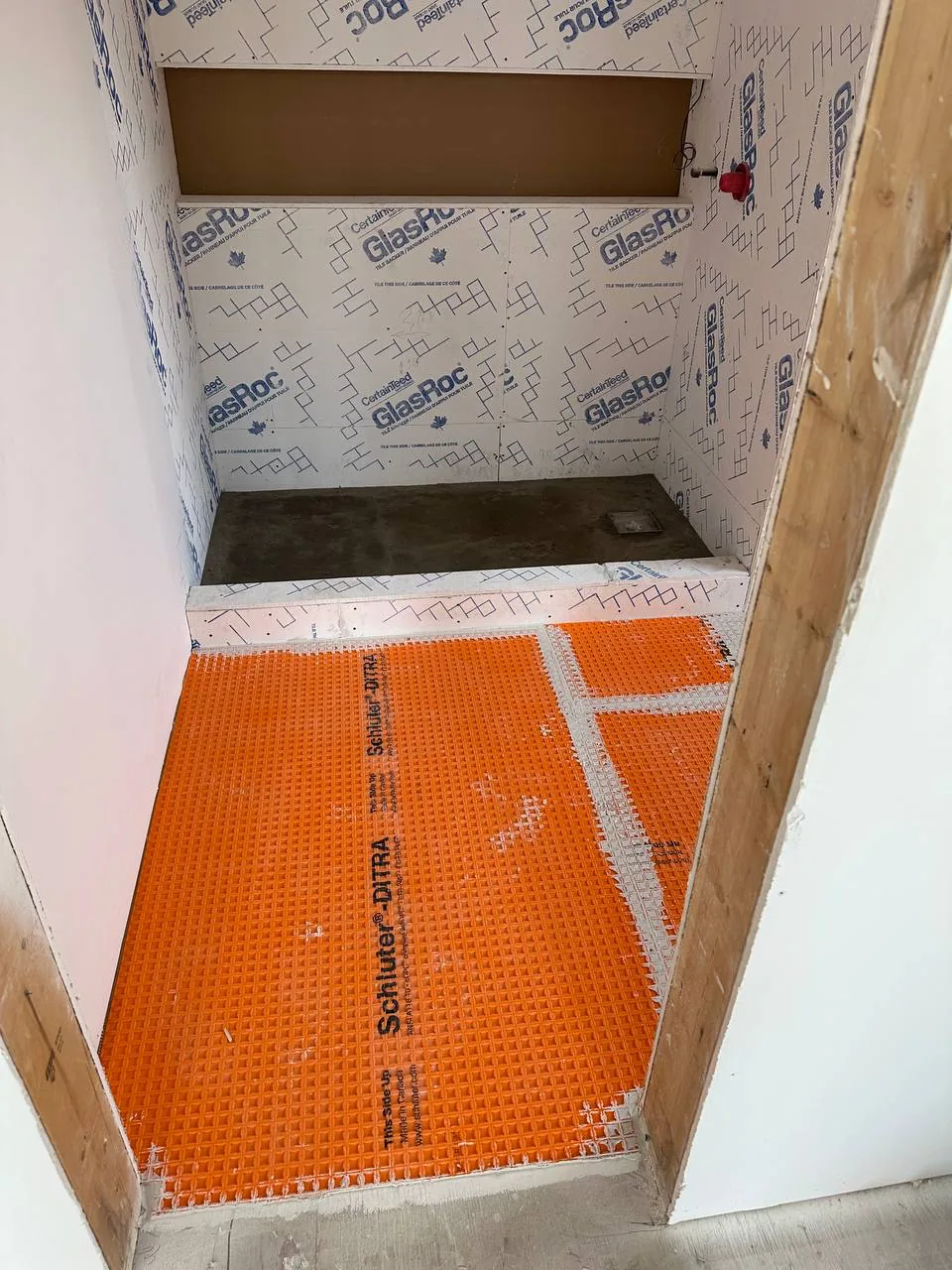
Uncoupling membrane across the whole floor, not just the wet area
What it costs
What actually moves the number.
Anyone quoting this job without seeing these four things is guessing, and the guess gets corrected halfway through the work.
-
What the old floor is stuck to and with what
Tile on a thick mortar bed is a different day from tile on backer board. Old adhesive on a slab can be the slowest part of the entire job.
-
How much of it there is, and how the debris leaves
Weight, not volume. A second-floor bathroom carried down a staircase and a basement with a walkout are not the same removal.
-
What is found underneath
Rot, deflection or a slab that needs 20 mm of compound all change the preparation. This is the honest unknown in every quote, and it is why the quote separates the known scope from what may be found.
-
Dust protection needed
An empty house is quick to set up. An occupied home with an open-plan main floor needs real containment, and that takes time.
Get a quote
Six short questions. A written price the same day.
No site visit to get a number, and no sales call afterwards. If the budget is not right, you will know from the reply instead of from an afternoon off work.
Rather just talk? (437) 875-1982 · English, русский, українська
- Liability insurance in place. Certificate on request.
- Written warranty on the workmanship, on request.
Questions
What people ask about this job.
Can new tile go over old tile?
Technically sometimes; usually it is a bad trade. The floor ends up high at the doorways and against the appliances, and it inherits whatever was wrong with the old bed — including any movement. Removing costs less than fixing a floor that cracks.
How bad is the dust?
Manageable if it is planned for. Doorways sealed, the area sheeted and extraction at the tool keeps it in the room being worked on. Uncontrolled tile removal puts silica dust through an entire house.
What happens if rot is found under the old floor?
You see it, photographed, before anything covers it. The repair is priced and agreed before it is done — that is the point of opening the floor before finalising the scope.
Do you take the debris away?
Yes. Removal and disposal are part of the job, not something to arrange separately.